Why Is My Google Ads Cost Per Click So High? 8 Causes and Fixes
High Google Ads CPC is not always a bidding problem. Here are eight practical causes to check before simply lowering your bids, from ad relevance and search terms to landing pages and conversion tracking.
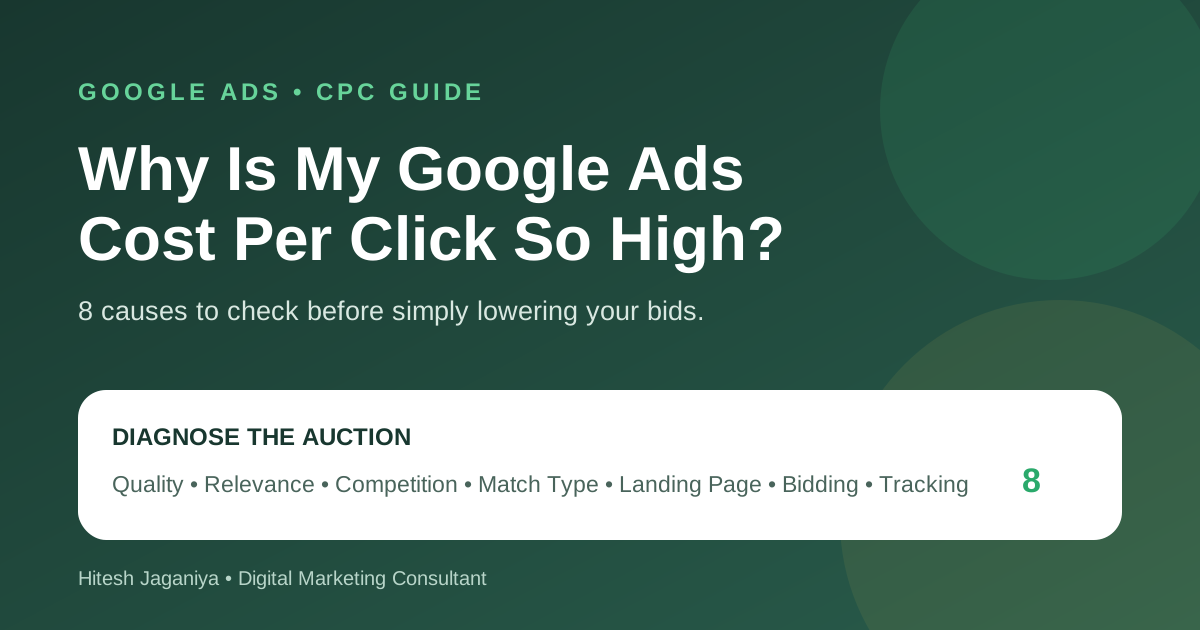
High CPC is not automatically a bidding problem. Actual CPC comes from the auction and can be affected by bid, ad quality, competition, Ad Rank thresholds, search context and other auction-time factors. Diagnose those inputs before simply lowering bids.
High CPC is usually treated as a bidding problem, and that's why many attempts to fix it don't work. Someone lowers the max bid, impressions collapse, and they end up with a slightly cheaper click that is no longer reaching the people worth reaching.
Cost per click is an output, not a single setting. It's what falls out of the auction after Google evaluates your bid alongside ad quality, competition, context and other factors. So the fix often sits somewhere other than the bid field.
I'm Hitesh Jaganiya, a digital marketing consultant certified in Google Ads and Google Analytics. Here are the eight causes I check when an account has a CPC problem, roughly in the order I would investigate them.
1. Your Quality Score Signals May Be Weak
Quality Score is a keyword-level diagnostic tool from 1–10. Google says it is not itself an input into the ad auction; instead, it helps you understand three important areas of ad quality: expected click-through rate, ad relevance and landing page experience. Those quality signals can affect Ad Rank and actual CPC.
Add the Quality Score column in your keyword view, then add the three component columns — Expected CTR, Ad Relevance and Landing Page Experience. Look for “Below average” signals first, rather than treating the 1–10 score as a target to maximize.
The fix: work on the component that is weakest. If ad relevance is below average, the next section is often where the problem begins.
2. Your Ad Groups Are Too Broad
A single ad group with thirty loosely related keywords makes it harder to write ads that speak precisely to the searches you're targeting. Relevance can suffer, and the account becomes harder to diagnose.
I see this often in accounts built quickly — one ad group called “Services” holding every keyword the business could think of.
The fix: split keywords into tight themes where a single ad genuinely addresses the search intent. Google itself recommends splitting ad groups when different keywords cannot be easily addressed by the same ad.
3. You're Competing in an Expensive Auction Without Realising It
Some categories are simply competitive. In Ahmedabad, real estate, education, legal and financial services can have multiple advertisers competing for valuable searches. If more advertisers compete for the same demand, auction conditions can become more expensive.
Open Auction Insights under the relevant campaign's Insights section. It can show which advertisers overlap with you and how your visibility changes relative to them.
The fix: you cannot control competitors' bids, but you can control where you compete. More specific, intent-rich keywords can be a useful way to target narrower demand rather than fighting over only the broadest head terms.
4. Broad Match Is Pulling You Into Auctions You Never Chose
Broad match can be useful, but it can also surface searches that are only loosely related to what you sell. The important question is not whether broad match is “good” or “bad”; it is whether the actual searches it produces are commercially relevant for your business.
Check the Search terms report. If you're paying for clicks on queries that are not relevant to your offer, your average CPC can be inflated by traffic you would not have deliberately targeted.
The fix: add relevant negative keywords, review search terms regularly, and consider tighter match types for areas where you need more control while your conversion and negative-keyword data matures.
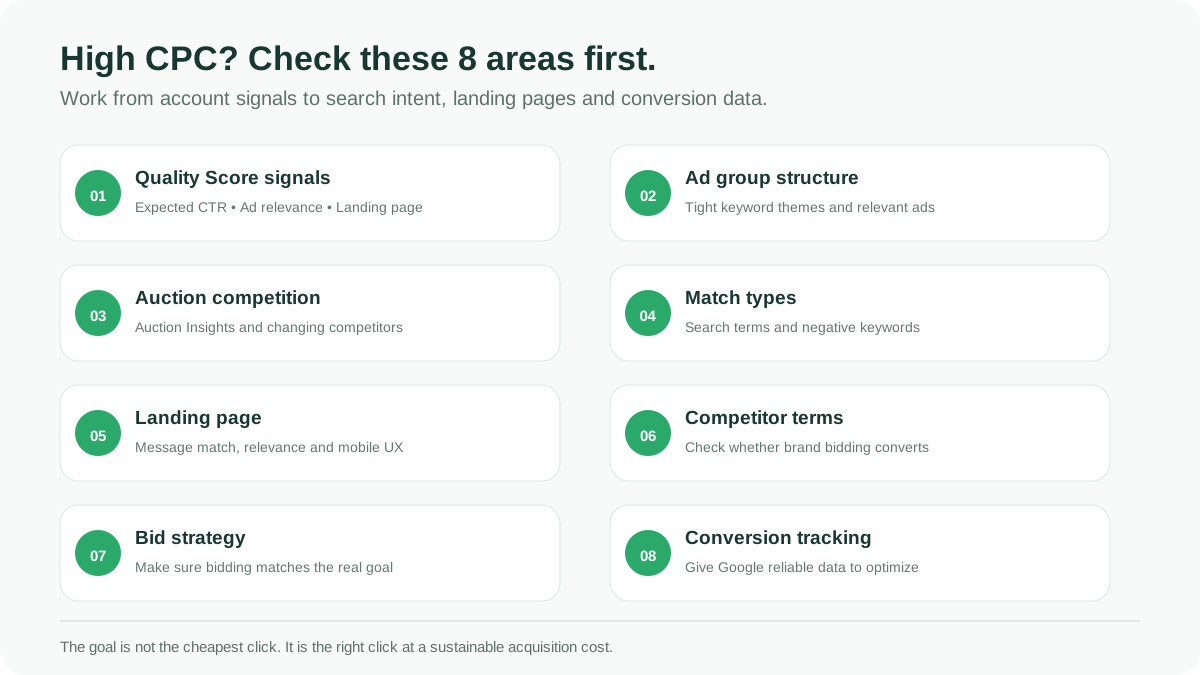
5. Your Landing Page Is Hurting You
Landing page experience is one of the three Quality Score components, and Google also considers the quality and relevance of the landing page in its auction-time ad quality assessment.
The common version of this problem is simple: every ad group points to the homepage. Someone searches for a specific service, clicks an ad about that service, and lands on a generic page where they have to hunt for what they came for.
The fix: match landing pages to ad groups where practical. Keep the promise in the keyword and ad aligned with the page, and check the mobile experience specifically.
For a broader account workflow, see my guide to 10 Google Ads optimization moves most accounts miss.
6. You're Bidding on Competitors' Brand Names
Competitor-brand bidding can be legitimate and sometimes commercially useful, but it can also be inefficient. A search for another company's name may be less relevant to your ad and landing page than a search for your own service, which can make the traffic harder to justify financially.
The fix: judge these keywords by qualified conversions and cost per acquisition, not clicks alone. If they generate clicks without producing enough business value, they deserve a closer look.
7. Your Bid Strategy Is Optimising for Something You Don't Want
Google Ads bidding strategies optimize toward the goal you select. A click-focused strategy is designed around clicks; conversion-focused strategies use conversion signals to pursue conversions. If the business goal is qualified leads or revenue but the campaign is effectively optimized toward cheap traffic, the account can spend money on outcomes that do not matter enough.
The fix: make sure the bidding strategy matches the actual business objective and that conversion actions are correctly configured. If you have enough reliable conversion data, evaluate conversion-focused bidding; if you do not, fix measurement first.
8. Your Conversion Tracking Is Broken or Missing
This underpins everything above. Without accurate conversion data, you have less information about which clicks create business value, and automated bidding has less reliable feedback to optimize against.
I've seen this in self-managed accounts where tracking was set up once, then quietly broke after a website change and nobody noticed.
The fix: verify in Google Ads under Goals → Conversions that your important conversion actions are recording recently and at a plausible volume. If tracking stopped, fix measurement before making major bidding changes.
My guide on reading Google Analytics and Search Console without an agency can help with the measurement side of the wider marketing system.
A Note on What “High” Actually Means
Before you spend weeks optimizing, ask whether your CPC is genuinely high or simply higher than you expected. A ₹90 click that converts at 8% into a customer worth ₹40,000 can be economically different from a ₹12 click that never produces a qualified lead.
The metric that matters is not CPC in isolation. Cost per acquisition, conversion rate, lead quality and customer value tell you whether the traffic is economically useful. Chasing the lowest possible CPC can reduce volume or quality if you cut the auctions that actually produce customers.
If you're deciding how to allocate your first paid-ad budget, my guide on Google Ads vs Meta Ads for Ahmedabad businesses covers intent, product type and budget considerations.
The 8-Point High CPC Checklist
- Review Quality Score components as diagnostics.
- Check whether ad groups are tightly themed.
- Review Auction Insights and competitive changes.
- Mine Search terms and add relevant negatives.
- Match landing pages to search intent.
- Evaluate competitor-brand traffic by conversions and CPA.
- Confirm the bid strategy matches the business goal.
- Verify conversion tracking before changing bids.
Frequently Asked Questions
Does lowering my bid reduce my cost per click?
It can, but it can also reduce eligibility, position or traffic volume. Actual CPC is determined by the auction, so reducing the bid is not the only lever available.
What's a good cost per click in India?
There is no single useful number. CPC varies widely by industry, query, location, competition and campaign setup. Compare CPC with conversion rate, CPA and customer value instead of using one national benchmark.
How quickly can I bring my CPC down?
Search-term exclusions, keyword restructuring and landing-page improvements can affect performance relatively quickly, but the timing varies by account volume and the type of change. Avoid judging a structural change from only a few clicks.
Does a higher budget lower my CPC?
Not directly. Budget controls how much traffic you can buy; it does not automatically make individual clicks cheaper.
Is a high CPC always a problem?
No. A high CPC can still be economically sensible if the resulting traffic produces enough qualified conversions and customer value. Evaluate the whole acquisition funnel.
Want to find what's driving your Google Ads costs?
If your CPC has climbed and you're not sure whether the problem is competition, relevance, search terms, landing pages or tracking, an account-level review can make the cause much easier to isolate.
Talk about your Google Ads account