Can AI Content Rank on Google? A Consultant's Honest Answer for 2026
Yes, AI-assisted content can rank — but the finished page still needs usefulness, accuracy, originality and human editorial judgment. Here's what the data and Google's guidance actually suggest.
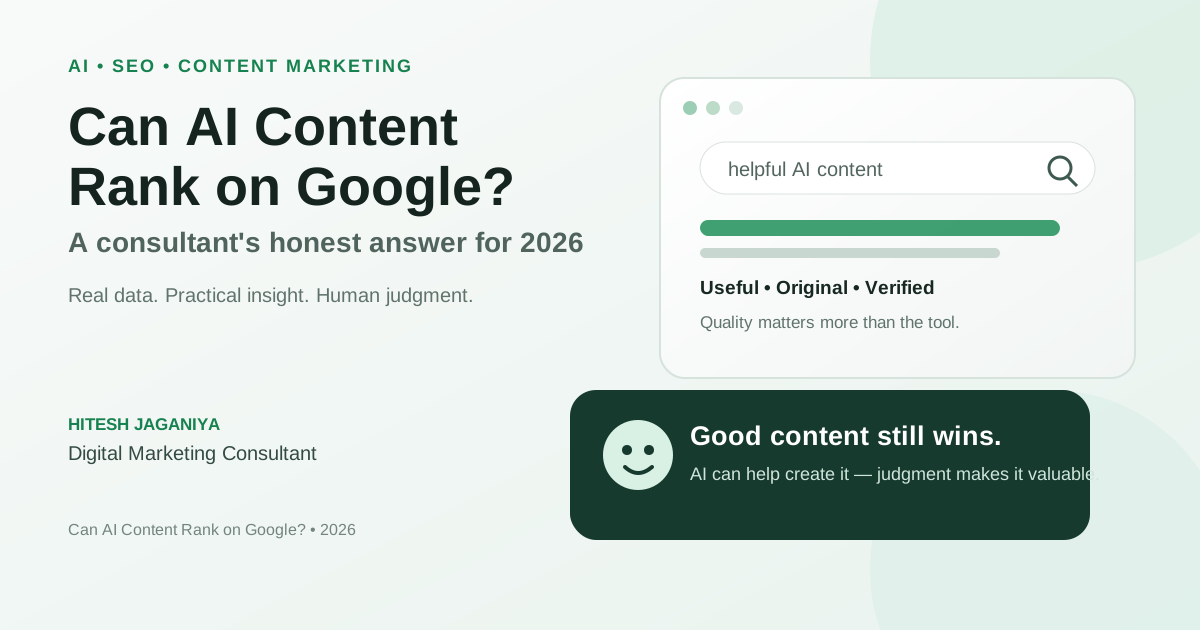
Yes, AI content can rank on Google in 2026. The important distinction is not whether AI was involved, but whether the finished page is useful, accurate, original and backed by real editorial judgment.
I get asked this question almost every week now, usually by a founder who's just tried an AI writing tool for the first time and either got excited about how fast it worked, or nervous that Google might quietly punish them for using it. Both reactions are understandable. Neither is quite right.
Yes, AI content can rank on Google in 2026 — but that answer needs more nuance than a yes or no. "AI content" covers everything from a lazy, unedited first draft dumped straight onto a page, to a carefully researched, fact-checked, expert-reviewed article that happened to start as an AI draft. Those two things can perform very differently in search.
I'm Hitesh Jaganiya, a digital marketing consultant with 11 years of experience, certified in Google Ads and Google Analytics. I want to walk through what's actually true here, based on real data and how Google has publicly explained its own position — not the extreme takes you'll see on either side of this debate.
What Google Actually Says About AI Content
Google's own position has been consistent since it first addressed this directly back in 2023: it rewards quality and usefulness, not a particular method of production. Content isn't penalized simply because AI was involved in writing it. Google's spam policies target content created primarily to manipulate rankings — including thin, mass-produced pages with little or no value added, regardless of whether a human or a machine typed them.
That distinction matters. The rule was never "no AI." The issue is content built mainly to trick the algorithm instead of helping a reader. AI has simply made it dramatically easier to produce that kind of low-value content at scale.
What the Actual Data Shows
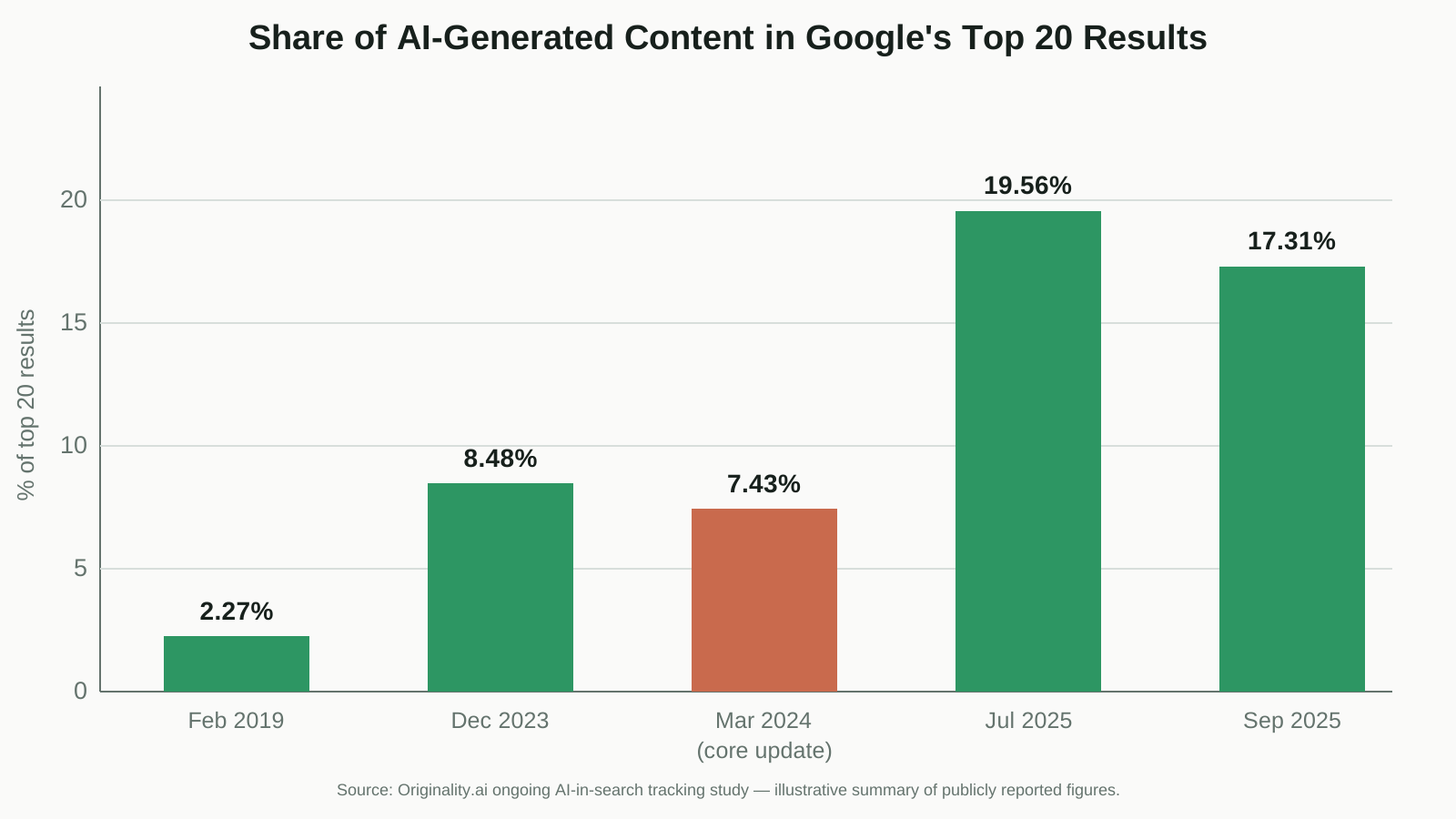
Independent tracking studies that sample Google's top search results over time have shown something useful: the share of AI-generated content appearing in top rankings has grown substantially since 2019, but it has not grown in a straight line. It dips around major Google algorithm updates and can climb again afterward.
Notice the dip around the March 2024 core update. The article's source material frames this as part of the broader quality shake-up around low-quality content. The later recovery does not mean quality standards disappeared; it is more consistent with the idea that some AI-assisted content can perform when it has enough editorial value.
Separately, research from SEO analytics firms looking at the correlation between how much of a page is AI-generated and where it ranks has found little meaningful relationship. In practical terms, whether a page started as an AI draft tells you far less about ranking potential than the quality of the finished work.
Why Most Unedited AI Content Still Fails to Rank
If AI content can rank, why does so much of it perform poorly? In my experience reviewing content for clients, it usually comes down to a few recurring problems.
It says nothing new. Raw AI output tends to converge toward generic points that already exist across the web. That makes it difficult to stand out when search engines are trying to surface genuinely useful answers.
It gets specifics wrong. Numbers, dates, local details and current information are areas where AI-generated text can make confident-sounding mistakes. A factual error can undermine an otherwise well-written page.
It has no real point of view. A page that explains a topic neutrally, like a textbook, may be less useful than one that applies real reasoning and experience. That is the approach I used in my research-led breakdown of benchmarking marketing KPIs, where the goal was to question a commonly repeated assumption rather than simply restate it.
How I'd Actually Use AI in a Content Workflow
I'll be straightforward about this: I use AI tools regularly in my own process, mainly for research organization, structuring a first draft, and speeding up parts of writing that do not require judgment. What I don't do is publish that first draft as-is.
Real experience gets added in. If I'm writing about something like local SEO for real estate businesses, the value is not in explaining what SEO is. The value is in the specific patterns and lessons from real client work that a generic model cannot directly access.
Every specific claim gets checked. Statistics, tool names, pricing figures and technical steps should be verified before publication, not assumed to be correct because the sentence sounds confident. For measurement topics, my guide to reading Analytics and Search Console takes the same practical approach.
The structure is built for people. Clear headings that match real questions, short paragraphs and content organized around reader intent matter more than stuffing keywords into every section.
It has to sound like someone who has actually done the work. Genuine field experience, specific examples and opinions formed through doing the work are difficult to reproduce with generic text alone.
How This Article Was Written
It would be strange to write a whole article about AI content without being clear about how this one was made: this post was drafted with AI assistance, then fact-checked, restructured and edited by me before publishing. The data points were checked against the source material rather than taken on trust. The opinions, framing and parts drawn from 11 years of doing this work are mine.
That is the process I'm recommending above. If you use automation in content creation, the important question is what human judgment and value you add before the page goes live.
AI Content vs. Human-Led Content: What I'd Tell a Founder
If you're deciding how to handle content for your business, AI can genuinely speed up research, drafting and getting a structure down. What it can't replace is the judgment about what is true, what is useful, and what your specific business or experience adds that a generic answer would not.
The businesses I see struggling with this treat AI as a replacement for expertise rather than a tool that speeds up expressing it. A better workflow is to use AI for the blank page and repetitive structure, then spend your attention on the parts that require a specific point of view, verification and real experience.
Frequently Asked Questions
Does Google penalize content just because AI was used to write it?
No. The source material describes Google as evaluating quality and usefulness rather than production method. The concern is thin, unhelpful content created mainly to manipulate rankings.
Can Google or AI detection tools reliably tell if content is AI-written?
Public AI detection tools can be inconsistent, particularly on content that mixes AI drafting with substantial human editing. The source material does not establish AI detection as a direct Google ranking signal.
Is fully human-written content still better than AI-assisted content for SEO?
The important comparison is the finished content. Unedited generic output can struggle, while well-researched, fact-checked, experience-backed content can perform regardless of whether AI helped with the first draft.
How much editing does AI-generated content need before publishing?
Enough to add something genuinely useful: real experience, verified facts and a specific point of view. A light grammar pass is usually not enough.
Should a small business avoid AI tools entirely to stay safe with Google?
No. AI can support research and drafting. The larger content-quality risk is publishing unedited, generic output at scale without expertise or verification behind it.
More practical SEO reading
If you're building a content strategy around AI, start with the fundamentals too: Google Ads optimization, measurement, local SEO and content that answers a real customer question.