Digital Marketing for CA Firms in Ahmedabad: What ICAI Actually Allows
What can a CA firm in Ahmedabad actually do online after the 2026 ICAI changes? A practical guide to websites, SEO, LinkedIn, Google Business Profile, reviews and paid advertising.
Most articles on this topic are written by agencies who've never read the Code of Ethics. They'll tell a CA firm to collect Google reviews, publish client case studies, and run ads calling themselves the leading tax advisors in Ahmedabad — all of which range from questionable to flatly prohibited.
That matters here more than in any other industry I work with. For a restaurant, bad marketing advice costs money. For a chartered accountant, it puts an ICAI membership at risk.
I'm Hitesh Jaganiya, a digital marketing consultant with 11 years of experience, certified in Google Ads and Google Analytics. This is a guide to what actually works for CA firms in Ahmedabad, written to sit inside the rules rather than around them.
What Changed in April 2026 — and What Didn't
ICAI approved significant reforms to its advertising and website guidelines at the 447th Council Meeting in December 2025, as part of the 13th Edition of the Code of Ethics, effective 1 April 2026. It was the most meaningful loosening in over two decades.
But there's a lot of overstated content circulating about this, much of it published by web design agencies selling to CA firms. So let me be precise about what didn't change.
The core prohibition stands. Clause 6, Part I of the First Schedule to the Chartered Accountants Act, 1949 still prohibits a chartered accountant from soliciting professional work through advertisement. The 2026 reforms gave more flexibility in how firms present themselves. They did not open the door to advertising in the ordinary commercial sense.
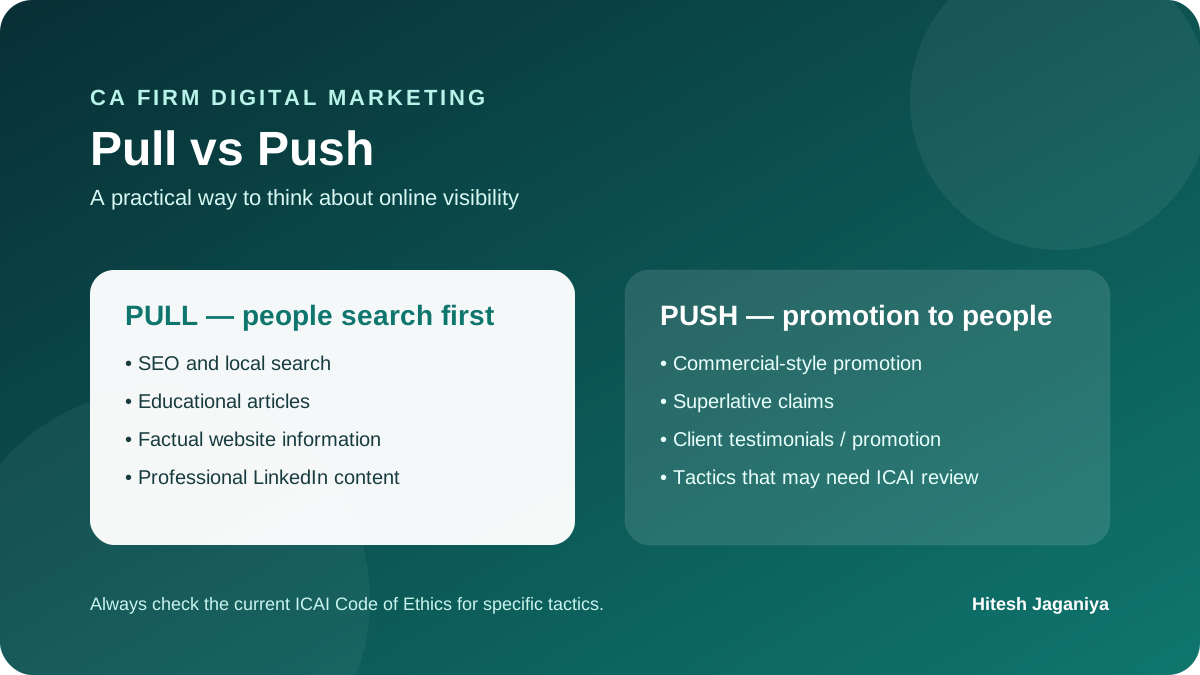
The useful mental model is pull versus push. Information a prospective client finds when they go looking — permitted, and now with more latitude than before. Promotion pushed at people who didn't ask — still prohibited for services exclusive to the profession.
What You Can Do
Based on the 13th Edition guidelines, a CA firm in Ahmedabad can:
- Maintain a professional website with factual information about the firm, its partners, services, and areas of expertise
- Include the firm name with the Chartered Accountants suffix, ICAI firm registration number, and year of establishment on its own website
- Maintain a LinkedIn presence and other social profiles
- Publish educational and technical content — explainers on GST changes, filing deadlines, regulatory updates, compliance requirements
- List on Google Business Profile and legitimate directories
- Send email newsletters and client alerts
- Host informational webinars
- Post job vacancies
The 2026 update also permits push-mode promotion for services that aren't exclusive to the CA profession — general accounting, bookkeeping, advisory and consultancy work. That's a genuine opening, but it needs care: the distinction between an exclusive and non-exclusive service isn't always obvious, and the safe approach is to treat anything statutory as off-limits for push promotion.
What You Still Cannot Do
This is the part agencies get wrong, and it's worth being blunt about.
No client testimonials or reviews, anywhere. Not on your website, not on social media, not in a brochure. This is one of the clearest prohibitions and it survived the 2026 reforms intact. It also means the standard local-SEO playbook of actively soliciting Google reviews doesn't transfer to a CA firm.
No superlative or comparative claims. "Leading CA firm in Ahmedabad," "best tax consultants in Gujarat," "better than other firms" — all prohibited. Your copy has to be factual and objective, not promotional.
No client case studies showing actual work performed. You can write about a regulatory topic in depth. You cannot write "how we saved a Naroda manufacturer ₹40 lakhs in tax."
No banner advertising on websites. Unchanged.
No Chartered Accountants suffix on commercial aggregator listings, and firms may not list on commercial aggregator platforms for services reserved exclusively to the profession.
One honest caveat: I'm a marketing consultant, not a professional-conduct expert, and these rules carry real consequences. Read the Code of Ethics yourself, and if a specific tactic sits in grey territory, check with ICAI or your professional advisor rather than with your marketing agency. It's your membership on the line, not your agency's retainer.
So What Actually Works for a CA Firm in Ahmedabad?
Here's the thing — the constraints push you toward a strategy that happens to work genuinely well. When you can't shout, you have to be found. That's just SEO and content, done properly.
Educational content is your strongest channel
This is permitted, it's what ICAI explicitly encourages, and it's what people actually search for.
Your prospective clients in Ahmedabad are searching things like: GST registration requirements for a new business in Gujarat, what the current filing deadlines are, whether a particular expense is deductible, how to handle a specific notice. Every one of those is a question you answer for clients weekly.
Writing clear, accurate explainers on these does three things at once. It ranks for genuine search demand, it demonstrates competence without claiming it, and it stays entirely inside the rules because it's information, not solicitation. If you're building the technical side as well, my guide to SEO strategy for 2027 covers the broader search shifts that matter for Indian businesses.
The firms that do this well in India tend to publish consistently on regulatory changes — not generic "importance of tax planning" content, but specific, timely, useful pieces that a business owner genuinely can't get elsewhere without paying someone.
Google Business Profile — with a caveat
A Business Profile is permitted and worth setting up properly. It's how people find a firm's address, hours, and contact details, and it affects local map visibility significantly.
The caveat is reviews. Normally I'd tell a local business that actively asking clients for reviews is the single highest-return free action available. For a CA firm, publishing or soliciting client appreciation runs into the testimonial prohibition, so this is exactly the kind of grey area to clear with ICAI rather than assume.
What you can do without ambiguity: complete the profile accurately, keep hours current, add real photographs of the office, and select the right category. I've written separately about why a business sometimes doesn't appear on Google Maps in Ahmedabad — the troubleshooting principles apply here, minus the review-building sections.
LinkedIn is the strongest newly-permitted channel
For professional services in India, LinkedIn is where the decision-makers are, and the 2026 guidelines gave firms clearer room to operate there.
What works: partners posting substantive commentary on regulatory developments under their own names. Not firm promotion — professional observation. A partner explaining what a recent CBDT circular means in practice will reach more relevant people in Ahmedabad than any amount of firm-level posting.
Local search visibility
Someone searching "CA firm near Ashram Road" or "chartered accountant Satellite Ahmedabad" is looking for a firm to engage. Being findable for those searches is permitted — it's pull, not push.
That means the ordinary technical work: a fast, mobile-friendly site, accurate and consistent name/address/phone details everywhere they appear, clear service pages written factually, and local signals done properly. For the measurement side, see my guide on how to read Google Analytics and Search Console without an agency.
What about Google Ads?
This is the genuine grey zone, and I'd treat it cautiously.
Running paid search for services exclusively reserved to chartered accountants looks a lot like solicitation, whatever the 2026 flexibility on non-exclusive services. For genuinely non-exclusive offerings — bookkeeping, business advisory, outsourced accounting — there may be room, but the ad copy would still need to avoid superlatives and comparative claims, which rules out most of what makes ad copy work.
My honest position: for a CA firm, the effort is better spent on organic visibility and content, where the rules are clear and the long-term return is better anyway. If a firm does want to explore paid, that specific question belongs with ICAI before a rupee is spent. If you are evaluating paid-search mechanics separately, see how Google Ads Quality Score works.
A Realistic Starting Point
If I were advising a CA firm in Ahmedabad with no real digital presence, the order would be:
- A factual, professional website that loads fast and clearly states what the firm does and who's in it
- Google Business Profile completed properly, with accurate details and real photos
- A content habit — one genuinely useful piece a month on a regulatory topic the firm's clients actually ask about
- Partner-level LinkedIn activity, substantive rather than promotional
- Consistency checks — the firm's details identical everywhere online
That's unglamorous, and it's slower than advertising. It also compounds, stays compliant, and builds the kind of professional credibility that matters more in this field than reach does.
Frequently Asked Questions
Can CA firms in India advertise after the 2026 ICAI changes?
Not in the ordinary commercial sense. The 13th Edition Code of Ethics, effective 1 April 2026, gave more flexibility in website and content presentation and allowed push-mode promotion for non-exclusive services, but the prohibition on soliciting professional work through advertisement remains in force.
Can a CA firm collect Google reviews?
Publishing client testimonials or appreciation is prohibited under the Code. Because a Google review is client-published rather than firm-published, this sits in genuine grey territory — it's worth clarifying with ICAI rather than assuming either way.
Can a CA firm have a website in Ahmedabad?
Yes. Firms may maintain a professional website with factual information including firm name with the Chartered Accountants suffix, ICAI registration number, services, and partner details. It must function as an information resource rather than a sales platform.
What kind of content can a CA firm publish?
Educational and technical material — regulatory updates, compliance explainers, filing requirements, analysis of changes in tax law. What's prohibited is promotional content, comparative claims, and case studies describing specific client work.
Is LinkedIn allowed for chartered accountants?
Yes, and it's one of the clearer gains from the 2026 update. Professional updates, industry insight, and educational content are permitted. Direct solicitation and superlative claims about the firm are not.
This article covers marketing practice, not professional conduct advice. ICAI's Code of Ethics governs what members may do, and the consequences of getting it wrong fall on the member. Verify specific tactics against the current Code or with ICAI directly before implementing them.