ChatGPT Ads Are Live in India. Should You Actually Spend Money on Them?
ChatGPT Ads have arrived in India. Here's what the early campaign data says, who has a real case for testing the channel, and where the format is still too immature to justify spend.
On this page
ChatGPT Ads are now available to advertisers in India, but early evidence suggests they should be treated as a controlled test rather than an automatic replacement for established ad channels.
Primary keyword: ChatGPT Ads India • Related terms: ChatGPT advertising, ChatGPT Ads Manager
ChatGPT Ads Are Live in India. Should You Actually Spend Money on Them?
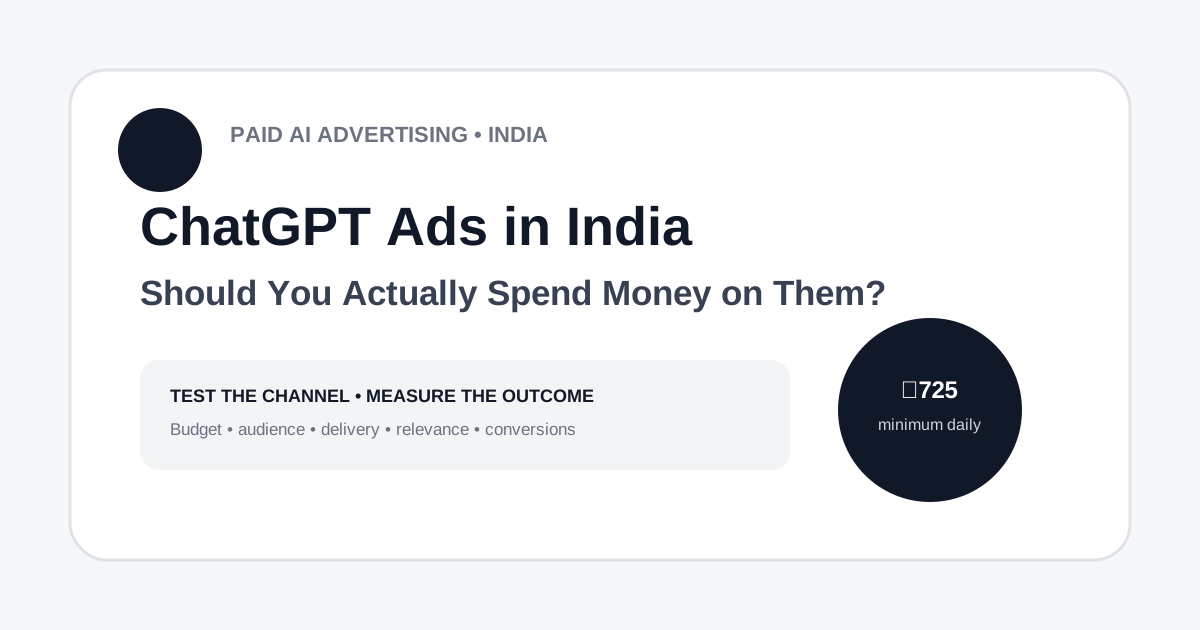
OpenAI switched on ChatGPT Ads for Indian users on 27 August 2026, and the self-serve Ads Manager opened to Indian advertisers on 4 September. Billing is in rupees, the minimum daily budget is ₹725, and there's no invitation process or spend commitment. In other words, any business reading this can open an account today and start spending by this afternoon.
Which is exactly why it's worth slowing down. A new ad channel arriving is not the same as a new ad channel working, and there's now enough published data to make a reasonably informed judgment rather than a guess.
I'm Hitesh Jaganiya, a digital marketing consultant certified in Google Ads and Google Analytics. Here's what the format actually is, what the performance data shows so far, and who has a genuine case for testing it.
What ChatGPT Ads Actually Are
They're sponsored cards that appear below a ChatGPT answer when the system judges your offer relevant to the conversation someone is having. The card carries a brand name, favicon, headline, short description, image, and a link to your page.
The structural difference from Google Ads matters more than the format: you don't bid on keywords. Instead you write what OpenAI calls context hints — a description of the audience, their task, and the situation where your product helps. The system reads the live conversation and decides whether you fit. It's closer to briefing a salesperson on your ideal customer than to building a keyword list.
Three objectives are available: Reach (paying per thousand impressions), Clicks (paying per click), and Conversions (optimising toward a tracked event, still billed per click).
If you're comparing this with established search advertising, my guide to Google Ads optimization explains why account structure, search intent and conversion signals still matter on channels with more mature diagnostic data.
Who Actually Sees These Ads
Ads appear for people on ChatGPT's Free and Go plans. Paid tiers — Plus, Pro, Business, Enterprise, Edu — carry no ads at all. Accounts identified as belonging to under-18 users are excluded, and free users can opt out of ads in exchange for fewer daily messages.
This single fact decides whether the channel can work for you. Your ad reaches people who haven't paid for ChatGPT. If you sell to professionals, agencies, developers, or anyone who uses AI tools heavily enough to subscribe, the people most likely to buy from you are precisely the people who will never see your ad.
There's a wrinkle specific to India, and it cuts both ways. Paid software subscription rates in India generally run lower than in the US, so the ad-eligible share of Indian ChatGPT users is likely proportionally larger than in the markets tested so far. That's genuinely a point in favour of testing here. But a larger free-tier pool also skews further toward casual and exploratory users rather than buyers — more reach, softer intent.
Also worth knowing before you plan creative: health and medical topics, mental health, and political content are restricted categories on the platform.
What the Real Test Data Shows
SE Ranking published a detailed account of their own ChatGPT Ads campaign, and it's worth taking seriously precisely because the results weren't flattering to them.
They ran three campaigns across the US, Canada, Australia and New Zealand in June 2026 — eight ad groups, 48 ads. The reach was real: 97,131 impressions and 1,263 clicks at a 1.30% CTR, with a blended cost per click of $3.16, which was cheap relative to what they'd normally pay on search for the same terms.
Then the part that matters. The campaigns produced almost no sign-ups, and they stopped the test before spending the full planned budget.
Three findings I'd treat as planning assumptions
Delivery is extremely uneven. Two of their eight ad groups took roughly half of all impressions. Some strategically important themes barely served — one received under a thousand impressions across the entire test. If a use case matters to you but few people discuss it inside ChatGPT, you won't get delivery, however well the campaign is built.
You can't see what triggered your ads. There's no equivalent of the search terms report. Reporting is aggregated, which protects conversation privacy but removes the single most useful diagnostic tool in paid search. When relevance is off, you're guessing at the cause.
Relevance is genuinely imprecise. SE Ranking's wider study of 50,006 commercial prompts found roughly 14% of placements were no more topically related to the conversation than a randomly paired ad would have been. That's a meaningful share of spend landing in conversations unrelated to the offer.
What This Costs in Practice
The minimum daily budget in India is ₹725 per campaign, so the entry cost is low. The question is what you get for it.
One thing worth building into your planning: a daily budget on this platform is an average across a seven-day period, not a hard daily cap. Spend can reach up to twice the selected daily amount on a given day. If you're used to Google Ads behaviour, or if you're reconciling spend for a client, that assumption is now wrong by up to 100%.
Early reported costs in India have been described as an early-mover discount that will compress as more advertisers arrive — which is the normal pattern for any new auction. Whatever numbers you see quoted this month shouldn't be treated as durable.
The more useful comparison is against what you already run. I've written separately about why Google Ads cost per click gets high and what to do about it — and for most Indian businesses, the cost per qualified lead on existing channels is the benchmark ChatGPT Ads has to beat, not the cost per click.
Who Has a Genuine Case for Testing This Now
E-commerce and D2C brands
This is visibly where OpenAI is investing — product feeds, price and rating cards, conversion-optimised bidding for feed campaigns. If you have a catalogue and enough conversion volume for the system to learn from, this is the strongest current fit.
Consumer products with several attributes to compare
People genuinely use ChatGPT to think through purchase decisions with multiple variables. That's a natural opening.
Travel, education, and experience businesses
These involve planning conversations, which is exactly the context the format is built for.
Businesses with a short, measurable path from click to action
If your conversion takes months and nothing meaningful can be measured earlier, you can't evaluate the test at all.
Businesses that should probably wait
- Anyone selling primarily to professionals likely to be on paid ChatGPT plans
- Local service businesses with a small geographic radius, where matching conversation volume will be thin
- Anyone without working conversion tracking already in place — this channel is a bad place to discover your tracking is broken
- Businesses whose Google Ads or Meta accounts still have obvious unfixed problems
One Thing Worth Separating Clearly
Advertising on ChatGPT does not make ChatGPT recommend you.
SE Ranking's research found the advertiser's own domain appeared among the cited sources in the actual answer in only about 3.6% of placements. You can pay for a sponsored card sitting below an answer that recommends your competitor.
If your goal is being named when someone asks ChatGPT for a recommendation in your category, that's an organic visibility problem — content, citations, consistent presence across the sources models draw on. It isn't something this platform sells. Two separate workstreams, and conflating them is an expensive mistake.
For the broader SEO side of AI visibility, my guide to SEO strategy for 2027 covers how human-first content, specific intent and original information fit into that shift.
My Actual Recommendation
For e-commerce and D2C brands with working conversion tracking: run a small, tightly-capped test now, with stopping rules written down before you launch. Being early in an auction is a real advantage, and the learning has value even if the return doesn't.
For most other Indian businesses, particularly local service companies: understand the format, skip it this quarter. The money is almost certainly better spent fixing what's already running. An account with broken tracking or untested landing pages will waste more than a new channel will earn.
If you're evaluating whether your existing paid campaigns are ready for another channel, start with the fundamentals in my Google Analytics and Search Console guide and make sure you can actually measure what happens after the click.
Frequently Asked Questions
Are ChatGPT Ads available in India?
Yes. Ads went live for Indian users on 27 August 2026, and self-serve access through OpenAI Ads Manager opened to Indian advertisers on 4 September 2026, billed in rupees with no invitation required.
What is the minimum budget for ChatGPT Ads in India?
₹725 per day per campaign. Note that the daily budget functions as a seven-day average rather than a hard cap, so single-day spend can run higher.
Can I target keywords on ChatGPT Ads?
No. You write context hints describing your audience, their task, and the situation where your product helps. Negative keywords are available to exclude irrelevant contexts, but there's no keyword bidding.
Will advertising on ChatGPT get my brand mentioned in its answers?
No. Published research found advertisers' domains cited in the answer itself in only a small fraction of placements. Organic AI visibility is a separate effort from paid placement.
Should a small local business in India try ChatGPT Ads?
Generally not yet. Conversation volume matching a narrow local area will likely be thin, delivery unpredictable, and there's no way to diagnose why.
Sources
Campaign performance data is from SE Ranking's published account of its own test, by Yulia Deda and reviewed by Vadym Hryshchenko. India launch and availability details are from OpenAI's August 31, 2026 announcement and OpenAI's Ads Manager availability documentation.
ChatGPT Ads is changing quickly, so verify current budget, availability, eligibility and campaign settings in Ads Manager before committing significant spend.