Google Ads for Doctors and Clinics in Ahmedabad: What's Allowed and What Works
A practical guide for Ahmedabad clinics covering medical advertising restrictions, Google healthcare policy, local keyword targeting, landing pages, patient privacy, conversion tracking and budget planning.
On this page
This is marketing guidance, not legal clearance. Medical advertising rules and Google's healthcare policy can change. Confirm the current position with the NMC, your Gujarat state medical council and a qualified healthcare lawyer before launching campaigns.
Google Ads for Doctors and Clinics in Ahmedabad
Most Google Ads advice assumes you can say anything you like about your business. Doctors cannot, and that changes the whole approach.
I'm Hitesh Jaganiya, a digital marketing consultant with 11 years of experience, certified in Google Ads and Google Analytics. This guide covers the two sets of rules that apply to a clinic's ads, then explains how to build campaigns within them. For broader support, visit my homepage as a Digital Marketing Consultant in Ahmedabad.
One caveat: I'm not a lawyer, and medical advertising rules are interpreted by regulators, not marketers. Treat the regulatory section as a briefing to take to your state medical council or a healthcare lawyer, not as clearance.
Two Sets of Rules, Not One
1. Medical advertising rules in India
The article's regulatory starting point is the Indian Medical Council's professional conduct regulations (2002), which have historically restricted doctors from soliciting patients or advertising like a retailer. They allow limited factual information such as name, qualifications, registration details, address, contact details and consultation hours. The source draft notes that newer conduct regulations were notified in 2023 and then put in abeyance; verify the current position with the NMC and Gujarat state council before spending money.
Other laws can also apply, including the Drugs and Magic Remedies (Objectionable Advertisements) Act, restrictions under the PCPNDT Act on advertising pre-natal sex determination services, and consumer protection law on misleading claims. This is a summary, not a legal interpretation.
2. Google's healthcare and medicines policy
Google's policy is separate from the law and is enforced independently. It restricts promotion of prescription medicines, unapproved or unproven treatments and misleading health claims. Google also limits some uses of health-related information for ad targeting.
Passing one set of rules does not mean passing the other. A factual ad can still be disapproved by Google, and an approved ad can still raise a regulatory issue.
What This Means for Your Ad Copy
Avoid wording that could be interpreted as a promise or boast.
Avoid
- Guarantees such as “100% cure” or “guaranteed results”
- Unsubstantiated superlatives like “best doctor in Ahmedabad”
- Fear-based or miracle-treatment language
- Before-and-after claims that imply guaranteed outcomes
Use factual information
- Qualifications and registration details where appropriate
- Services provided and clinic location
- Consultation hours and appointment availability
- Languages spoken, if useful to patients
Patients often need to know that a clinic is qualified, nearby and available—not read exaggerated adjectives.
Which Searches to Bid On
Healthcare searches fall into two broad groups, and they behave differently.
Need-driven searches
Examples include “dentist near me,” “skin doctor in Satellite,” “child specialist Bopal” and “knee pain doctor Ahmedabad.” These indicate a patient looking for a provider or appointment.
Research searches
Queries such as “what causes migraines” or “is root canal painful” may bring visitors who are researching rather than ready to book. Educational content may be a better fit than paid acquisition for these queries.
Build campaigns around specialty plus service area, not just the whole city. A phrase such as “dermatologist near SG Highway” can be more specific than “dermatologist Ahmedabad.” Actual cost and volume depend on the auction and local demand.
Negative keywords matter
Consider excluding irrelevant searches such as jobs, salary, course, training, free, syllabus, PDF, notes and other terms that indicate job-seekers, students or unrelated intent. Review the search terms report frequently during the first weeks, and check each negative against the clinic's actual services.
The Landing Page Matters as Much as the Ad
Patients are choosing someone to trust with their health, so make essential information easy to find:
- Doctor's name, qualifications and registration details
- Clinic address, map and consultation timings
- Phone number and WhatsApp option that work on mobile
- A plain description of the services offered
- Genuine patient reviews where available and collected within applicable rules
Send each specialty's ad to a relevant specialty page rather than always sending every click to the homepage. That can improve relevance and the user experience. See how Quality Score affects what you pay.
Be Careful With Patient Data and Targeting
Google restricts personalised advertising based on sensitive health information. Remarketing audiences built around health conditions are generally not allowed, so do not plan to follow people around the internet after they visit a sensitive clinic page. Check the current personalised advertising policy before building audience-based campaigns.
Do not send information that identifies a patient or their condition into Google Ads or Analytics. This can include sensitive form values or URLs that reveal a specific condition. Track that an enquiry happened, not who made it or why, and review tags and analytics settings with a privacy-aware implementer.
Track Appointments, Not Just Clicks
For many clinics, meaningful conversions include phone calls, WhatsApp enquiries and appointment requests. A form submission alone may miss other valuable contacts.
Set up WhatsApp enquiry tracking, and define conversions carefully. A button tap is not the same as a confirmed appointment. Review event definitions regularly, and keep patient-identifying information out of analytics.
Local Search Carries Much of the Weight
For “doctor near me” searches, map results can be prominent. A complete, accurate Google Business Profile can support local discovery without a cost per click.
Before spending heavily, check that the profile is accurate. If it is not appearing, read why a business might not show on Google Maps and how to request genuine Google reviews ethically. Keep information consistent between the profile, landing page and ad assets.
Budget: Start With Patient Value, Not a Universal Number
Healthcare clicks in Ahmedabad vary substantially by specialty and competition. Cosmetic treatments, dental implants, fertility services and other high-value specialties may be more competitive than general practice. See indicative Google Ads cost ranges in Ahmedabad for broader planning context.
The source draft suggests ₹30,000–60,000 per month as a planning range for a competitive specialty and notes that very small budgets may not generate enough data to learn quickly. Treat these as estimates, not a promise or a requirement. Work out what a new patient is worth to the clinic over the first year, then decide what acquisition cost is sustainable.
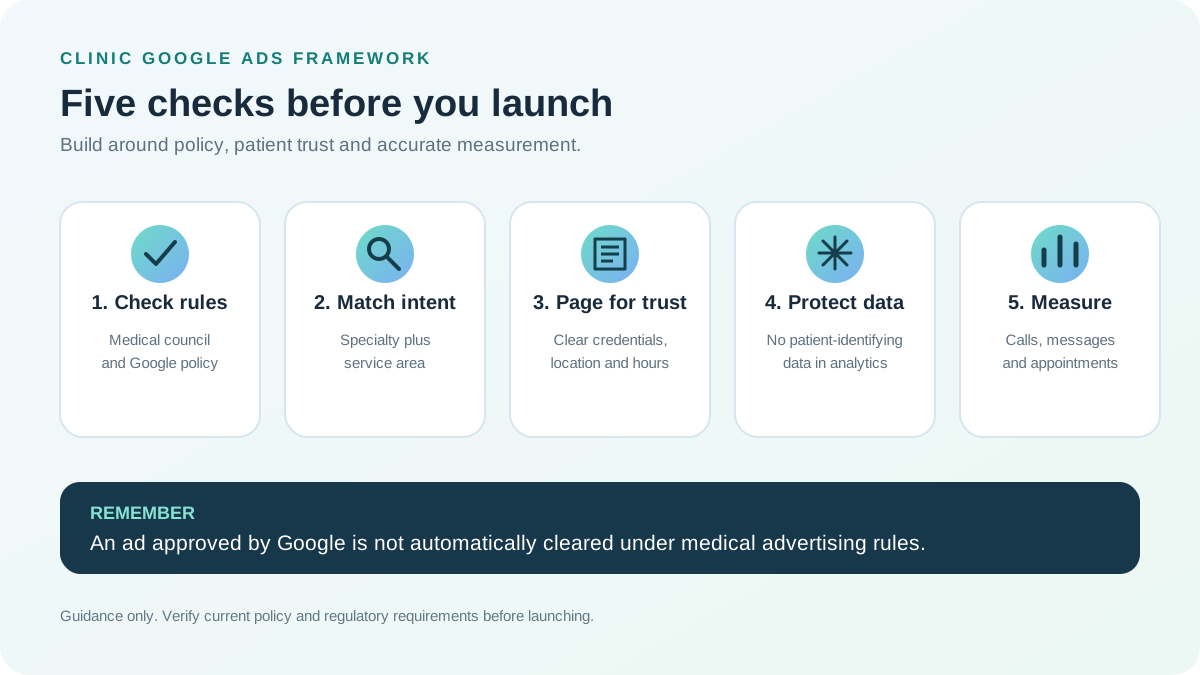
- Confirm regulatory and Google policy requirements.
- Choose a specialty and service area with clear intent.
- Use a factual landing page with working contact options.
- Check that analytics does not collect patient-identifying information.
- Define calls, WhatsApp enquiries and appointment requests as separate outcomes where possible.
Frequently Asked Questions
Can doctors advertise on Google in India?
Doctors are restricted from soliciting patients in the way a retail business would, and the permitted scope is set by medical council rules. Many clinics run factual, information-led ads, but confirm the current position with your state medical council before starting.
Does Google allow healthcare ads in India?
Google allows some healthcare advertising within its healthcare and medicines policy. Prescription drugs, unproven treatments, misleading claims and some forms of health-based targeting are restricted.
Can I use remarketing for my clinic?
Remarketing based on sensitive health conditions is generally restricted under Google's personalised advertising policy. Check the current policy before building audience-based campaigns.
What should a clinic's Google ad say?
Use relevant facts such as qualifications, services, location, consultation hours and appointment availability. Avoid guarantees, unverifiable superlatives and claims about outcomes.
How much should a clinic spend on Google Ads in Ahmedabad?
This guide uses ₹30,000–60,000 a month as a planning range for competitive specialties, not a guaranteed benchmark. The right budget depends on specialty, competition, conversion rate and the value of a new patient.
Is Google Ads or Google Business Profile better for a clinic?
They serve different roles. A complete, accurate Google Business Profile can help with local discovery at no cost per click; ads can add reach for specific specialties and service areas. Keep both accurate and compliant.
Next step
Build a clinic campaign around trust and clear measurement.
Check the rules first, make the ad factual, send visitors to the right specialty page and measure enquiries without exposing patient information.
Talk to a Digital Marketing Consultant in AhmedabadFor broader campaign planning, visit my homepage as a Digital Marketing Consultant in Ahmedabad.